
– a Talesmith short by Rajesh Muthuraj
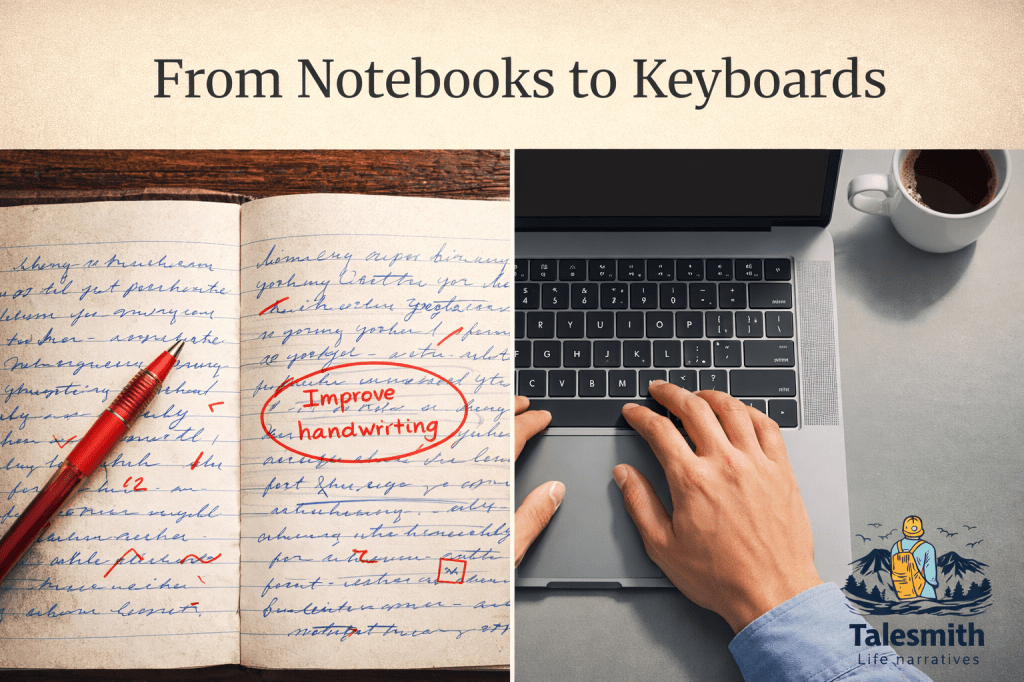
In school, handwriting was not just a skill. It was a character certificate.
Good handwriting meant you were sincere, obedient, probably drank milk on time, and would “go very far in life.” Bad handwriting meant you were careless, the most dangerous category known to teachers.
Every exam paper carried an invisible warning:
“Marks may be deducted if handwriting is not neat.”
No one knew how many marks. Could be one. Could be five. Could be your entire future. Teachers took handwriting personally. If a teacher couldn’t read your answer, it wasn’t their eyesight’s fault. It was your attitude. They would circle your answer in red and write:
Improve handwriting.
Improve it how? With age? With prayer? With a miracle?
At home, parents joined the mission.
Extra notebooks appeared.
“Write slowly.”
“Write beautifully.”
“Why are your A’s running away from your B’s?”
Some students wrote answers they didn’t know but wrote them beautifully.
Some students knew the answers, but their handwriting looked like ants had fought on the page.
Years passed. School ended. College ended. Life began.
And one day, that same student with criminal handwriting sat in an office, confidently typing an email at 80 words per minute.
No teacher. No red pen. No “improve handwriting.” Just a keyboard, where everyone’s handwriting looked the same.
The topper who once wrote like a greeting card now typed with two fingers and a lot of backspaces. The “bad handwriting” student? Thriving. Fast. Efficient. Accidentally sending emails without subject lines but still surviving.
That’s when we came face-to-face with reality.
We spent years perfecting handwriting for a world that would eventually ask: “Can you type and hit send?”
The notebook retired. The keyboard got promoted.
Moral:
Life doesn’t reward neat handwriting. It rewards adaptability. What looks like a flaw today might just be a skill waiting for the right keyboard tomorrow.


Leave a reply to Robert Sorna Cancel reply